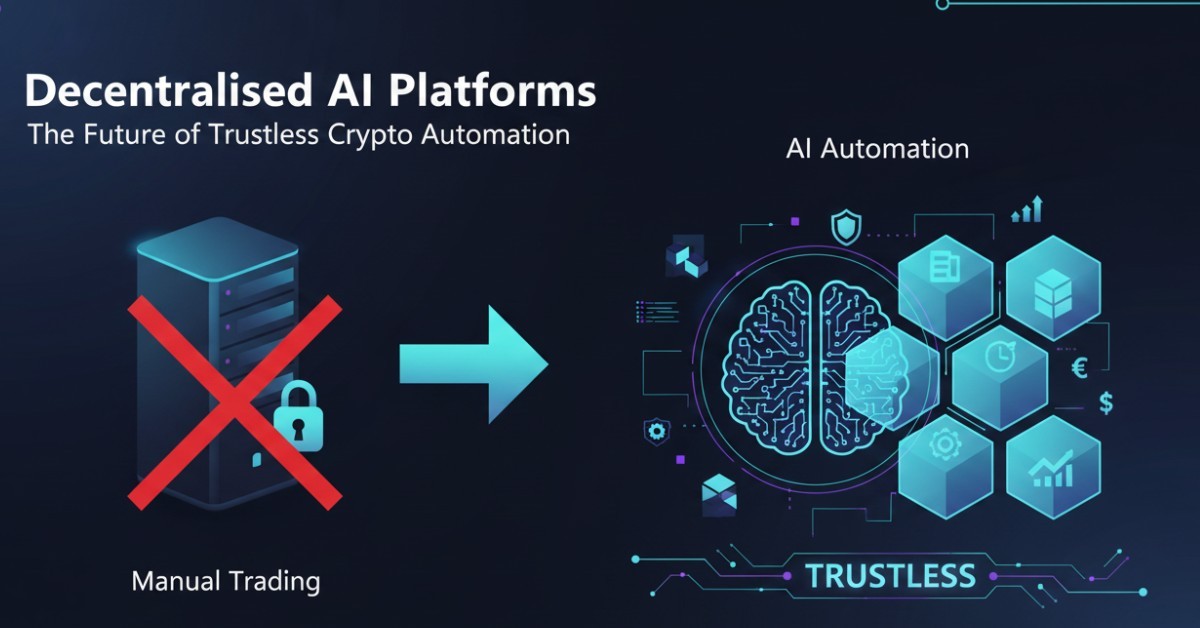
The decentralised AI platform shifts the web3 AI platform by shifting data processing to secure, peer-to-peer networks. By combining the AI web3 tools with blockchain, users deploy automated strategies safely. Driven by Trustless Systems, it replaces central middlemen with safe, secure and automated code.
A decentralised AI platform is a Web3 network that runs AI across peer-to-peer nodes rather than central servers. This architecture, utilised by advanced trading environments like Vision Makers, removes traditional single points of failure.
By relying on on-chain automation, the network uses all the trading, data tracking, and execution steps directly on the blockchain. This reduces the need for centralised servers.
Sources hardware power from independent nodes to run complex machine learning models. This eliminates reliance on expensive, monolithic cloud providers like AWS or Google Cloud.
Uses self-executing code to allocate network resources and trigger automated trades. This ensures all operations are executed exactly as coded without human intervention or bias.
Records data and model interactions securely to deal with manipulation. This provides a transparent, auditable trail that verifies the integrity of all the algorithmic decisions.
Feeds real-time market info into AI models by using secure, tamper-proof blockchain oracles. This way, the automated trading system reacts to the right, accurate, and manipulation-free data.
These leading platforms provide the infrastructure, data, and compute required for trustless Web3 automation.
Decentralised AI platforms are effectively redefining crypto automation by changing the control back to the user through trustless, peer-to-peer intelligence.
By merging machine learning with blockchain, decentralised AI erases the central vulnerabilities, creating a powerful Web3 ecosystem.
By eliminating central failure points, this integration secures crypto automation while advancing how users deploy AI trading crypto strategies.
Manual trading relies heavily on human emotion, constant screen monitoring, and limited execution speed, whereas AI for crypto trading drives disciplined, 24/7 precision across volatile markets.
Ultimately, shifting from manual effort to AI automation removes human error for faster and more consistent market execution. A crypto intelligence platform unlocks these automated efficiencies. It maintains data accuracy. It also secures decentralised networks.
AI agents turn Web3 into a self-executing network that runs without constant human input. These platforms deliver the core benefits of decentralised AI in crypto automation. They let users secure workflows. They also eliminate the need for third parties.
This allows AI crypto trading platforms to operate with total speed and precision.
By managing complex on-chain processes, AI agents turn static smart contracts into proactive, intelligent tools.
Smart contract automation shifts the manual blockchain execution with self-triggering, AI-driven protocols. These features monitor real-time network data to execute transactions, optimise costs, and rebalance assets instantly. By operating autonomously, they remove human error and maximise decentralised efficiency.
Decentralised AI integrates machine learning with blockchain networks to automate complex financial strategies safely and transparently.
Decentralised AI and blockchain are merging to create fully autonomous, secure, and self-evolving digital networks.
As these technologies mature, they will reshape the internet by shifting control from corporate tech giants to public, user-owned networks.
By shifting logic to trustless networks, AI crypto platforms maximise privacy, security, and market efficiency. These tools bridge the gap between analytical power and user sovereignty. They define the modern standard for decentralised finance.
Platform Built for Crypto Automation
It is a Web3 network that handles AI processing, data hosting, and machine learning tasks across a peer-to-peer network rather than using a single, centralised cloud company.
Distributed networks source computing power from independent nodes. Smart contracts later automate tasks, verify the actual data, and distribute blockchain rewards.
It means executing automated trading rules purely through mathematical algorithms and code. You never have to trust an exchange or broker with your private keys to run your strategies.
Decentralised hosting protects user data. Blockchain logs prevent tampering. AI detects anomalous routes to avoid vulnerable pools.
AI predicts market trends by managing complex data flows. It adjusts slippage protection based on real-time volatility. It also tracks smart contracts to flag fraud automatically.


