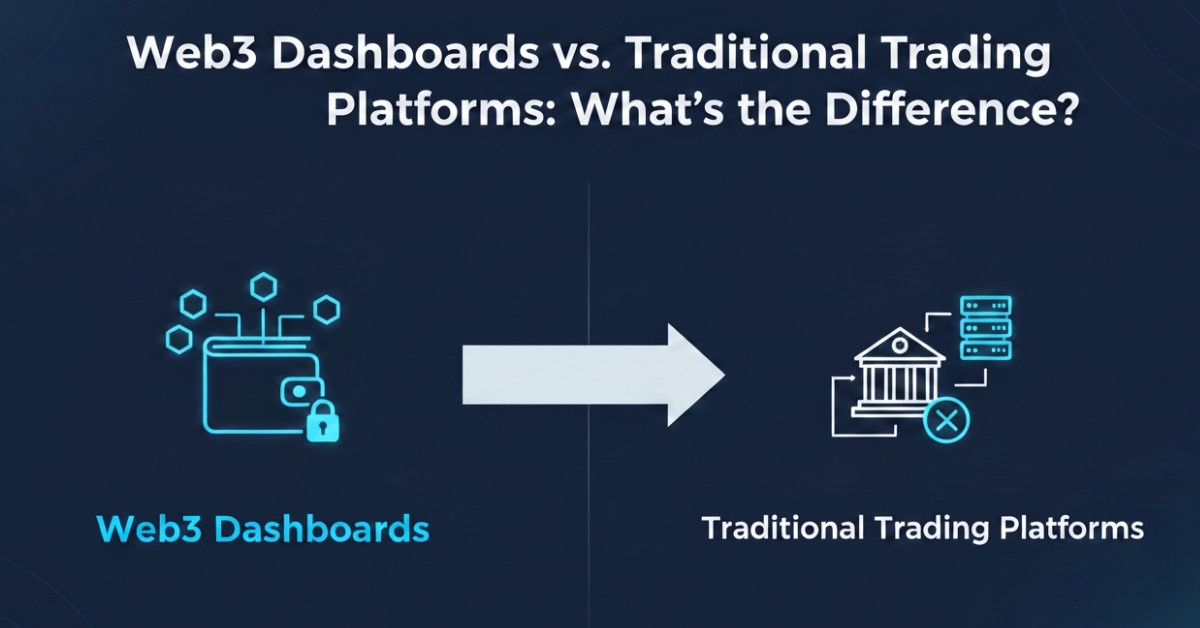
The financial view is split between traditional platforms and trading dashboard crypto. While traditional tools rely on cookies and IP addresses and remain blind to decentralised networks, a modern Web3 AI platform bridges this gap. Reading public blockchain data directly and in real-time, it allows traders to track assets securely without intermediaries.
A Web3 trading dashboard is a visual interface. It’s connected directly to the blockchain to aggregate and display decentralised asset data in real-time.
By eliminating centralised intermediaries, these dashboards give traders total control over their data and digital assets.
Traditional trading platforms are centralised software systems that connect users to legacy financial markets. They act as custodial intermediaries to facilitate asset management and order execution.
Choosing between them ultimately depends on whether you prioritise absolute asset ownership or familiar institutional guardrails.
Smart contracts play a major role in Web3 dashboards by automating trading, staking, swapping, and other blockchain activities. This way, it has the transparency, security, and speed while giving users ownership over digital assets.
While both environments allow users to interact with Trading Terminals, they operate on fundamentally opposing technological and operational frameworks.
Web3 dashboards help leave users in total control of their keys, while traditional platforms hold funds on private database ledgers.
Web3 uses permissionless wallet connections, whereas traditional systems require mandatory KYC documents and passwords.
Web3 tools read public blockchain ledgers in real-time, while traditional infrastructure remains blind to decentralised networks.
Web3 operates over the distributed, public peer-to-peer networks, while the legacy platforms depend upon the Centralised Exchanges (CEX) mainly.
The right way depends on balancing your need for autonomy against your preference for structural security. Both Web3 dashboards and traditional platforms offer distinct trade-offs regarding control, risk, and accessibility.
Ultimately, Web3 offers unmatched autonomy, while traditional platforms provide a safer, guided experience.
Modern Web3 trading dashboards integrate artificial intelligence to process massive amounts of on-chain data, giving traders a competitive edge through automated, real-time insights.
AI models analyse historical price trends and volume data to forecast future asset movements.
Natural language processing tracks social media and news to gauge market fear and greed instantly.
Algorithmic trading software monitors "whale" wallets and institutional flows to detect large-scale accumulation.
Machine learning scans smart contracts in real-time to flag potential rug pulls or code vulnerabilities.
AI identifies complex technical chart patterns and liquidity shifts faster than manual scanning.
Web3 dashboards transform user control by eliminating the centralised intermediaries that dictate financial access. Through a non-custodial wallet architecture and an intuitive User Interface (UI/UX), platforms like Vision Makers ensure users retain total ownership of their private keys and assets.
This shields them from platform insolvency risks. Instead of relying on invasive databases that require personal data, Web3 platforms grant permissionless, instant access directly to global markets.
For crypto traders, the crypto research tools and AI web3 dashboards are generally superior because they align natively with the Decentralised Exchanges (DEX) nature of digital assets, though traditional platforms still hold value for specific fiat-reliant strategies.
An AI trading platform helps investors find Web3 dashboards indispensable for true on-chain trading. These platforms leverage advanced AI for crypto trading to maximise efficiency. Meanwhile, traditional platforms are best kept as simple entry points. Use them primarily for fiat onboarding.
Traditional platforms excel in legacy markets but remain blind to decentralised environments. Web3 trading dashboards solve this by reading public blockchain data directly, using AI trading crypto to process data points instantly. A crypto intelligence platform unlocks these automated efficiencies while maintaining data accuracy and network security.
It is a non-custodial interface connecting directly to the blockchain. It aggregates on-chain data to track portfolios and execute trades.
Yes. Most advanced systems let users link multiple separate wallet addresses simultaneously. This consolidates historical balances into one interface.
They are highly secure because they do not hold user funds. However, safety depends entirely on users safeguarding private keys.
They offer advanced charting, deep order books, and fiat rails. However, they cannot read on-chain events or track decentralised tokens.
Yes. To understand how crypto dashboards work, they integrate AI and use smart contracts to let you swap tokens instantly without giving up asset ownership.


